
in a genuine feeling of sadness and meaningful longing. When abandoned or disrespected by others, the behaviour looks like depression or emotional withdrawal, whilst underneath there is a wish for revenge, full of rage and resentment. They extract all they need from others, use them to satisfy their narc needs and then toss them aside without any remorse or reflection. They have an empty void, an enraged self, full of impotent rage at being frustrated and unable to get their needs met, and fearful of a hostile world. They need to devalue everything they receive to prevent them from experiencing envy and want, with a regressive union of early object images, in which the ego clings to the uroboric stage, resulting in ego inflation through identification with grandiose images. A deficiency in line with the development of the grandiose self will lead to an absence of the capacity to pursue one’s goals and ambitions, which provide pleasure, reinforce one’s abilities, and help regulate self-esteem.
Transformation of Self as a bipolar configuration
- Mobilisation of archaic grandiosity and exhibitionsim into central self-assertion, goals, values and ambitions
- Mobilisation of archaic idealisation into idealised values, attributes and grounding principles
Dominant features of narcissistic character
- Rejects the interpretation: they have little effect, are emotionally vague, and are non-existent within and between sessions. Little is taken in, reflected on and modified. The experience was that interpretation was useless, ineffective, and even destructive.
- Can’t tolerate criticism: fragile sense of self, where interaction is felt as threatening, hostile and judgmental to a grandiose image.
- Lacks penetration: one is kept away at a distance, warded off, with a tight and tense body structure; everything discussed is transformed into a story or fantasy about themselves, which excludes participation
- Low empathy: aloof. disconnected and self-centred.
- Takes pride in having no needs: rejects feelings of need, experiencing needs can unleash rage and envy that could flood the weak ego structure. They can do lots for others, but if their need for sympathy or relatedness is kindled, this is experienced as a blow to their self-esteem and leads to depression and low energy.
- Lacks a sense of history or process. History is distorted, met with unrealistic responses and inner demands of omnipotence. It is not what happens in reality, but how events can be twisted to meet their inner grandiose pressure. poor relationship to inner psychic processes due to a lack of a positive archetypal or father constellation.
- Disturbed masculine and feminine functioning: the feminine realm of being (relatedness to the self) is absent, crushed by the power drive and compulsion of the inflated ego. The value of self is usurped by ego, whereby the positive significance of suffering is denied, oriented towards outer appearance rather than inner beauty and growth. When the positive anima (inner feminine) is present, there is potential for internal mirroring for the ego and self to enter into a relationship. The emergence of a positive animus (inner masculine) yields reflection and objectivity. transformation of the contra-sexual components results in a capacity for union and outer relationships, with the resurrection of the connection archetype.
- Potential for positive archetypal constellations: negative aspects of the mother and self are dominant; the inner experience is full of hate, rage, envy, and crushing demands, leaving one feeling empty and abandoned. A sense of being unborn, not birthing one’s potential and abilities. until the inner world constellates positively, reflection and imagination are superficial; flashiness and artificiality substitute for depth.

Problems of Rage and Envy
Their rage has an unforgiving quality, living unconsciously, seemingly untouched by the events that follow a wounding. Envy, the felt conviction that “anything I need will be withheld from me, so I will spoil or destroy the withholding object”, is one of the most difficult emotions to experience and integrate. the withholding of each other’s needs, such as encouragement, warmth, comfort and admiration. Is it not unusual for a parent to envy their child’s abilities and talents? “You have something special, and I hate you for it “. The sense of specialness is continuously inflated as a defence against feeling hated. A person may envy their friend’s prowess, business acumen and beauty. Individuals facing the pressure of an inner, creative task often experience rage at their own feelings of inferiority. Rage stems from a lack of self-esteem, narcissistic injuries suffered by their own creative block and ineptitude. A woman becomes the desperately needed feminine side of the man, and men are envied by women for their objectivity and masculinity.
The term idealisation denotes a process whereby another person is viewed as all good and all powerful, benevolent and wise, with no qualities that detract from perfection. They do not possess the darker human qualities of rage, hate, deceit, shallowness, power drives, manipulation, and envy. idealisation can serve as a defence against experiencing such negative feelings, or represent the healthy mobilisation of the positive self, projecting one’s potential and better qualities to another. The spirit archetype, often experienced through this idealisation projection, is behind an individual’s sense of creativity and purpose, as well as the values of psychic struture. The role of this archetype in creating the capacity to assimilate the energy of instinctual life, where the conscious ego gains strength, is enhanced by power and capacity for self-control. normally projected onto the mother, who represents the goddess of wisdom (sophia), and later onto the archetypal father. If this spirit archetype is lacking in parents who are emotionally unavailable and instinctually dead, this projection is usually rejected. The parents must accept being treated by the child as though they are invincible, perfect and all-powerful.
A godlike projection of spirit is accepted.
Mirroring Transference
To be mirrored is to be understood; someone empathetically follows our thoughts, feelings and experiences. A glaring deficiency in our culture is valuing being right over being related. To mirror a person requires a willingness to enter into their world, suspend critical judgment, reflect, and contain what is being offered. Mirroring is the externalisation of the internal psychic reality. The ego’s stability and robustness depend on an inner sense of being mirrored by the self. In the individuation process, the ego is continuously challenged to develop greater wholeness and integration of disparate parts. , with a need for external mirroring at each stage. The symbiotic relationship between mother and child, a shared energy field, must have a mirroring quality in which both parties penetrate and affect one another. The emerging child’s consciousness and anxiety must be acknowledged and absorbed by the mother. A mother must be capable of mediating, sensitive to the disorder of the child’s emerging consciousness, as she is the first carrier of the archetypal image, the central source of order within the personality. continuing the child’s anxiety helps develop a positive self, an internal reality for the child, with an inner sense of grounding and security. Otherwise, all change will be fraught with anxiety and fear, fragmentation and a chronically diffuse identity. The mother needs to recognise and mirror the child’s unique omnipotence, vulnerability, and especially their exhibitionism, often manifesting within the field of sexual and aggressive energies. The child will feel really seen, accepted, and listened to; a healthy ego-self relationship will form. The growing ego will gain an effective sense of power and effectiveness, whereby ambition will be realistic and appropriate. a sense of self-esteem will exist, rooted in stability in outer tasks, especially in creative and instinctual functioning, body awareness, and vitality.

Compulsive doing can change into reflection and give way to a positive spirit invested in the self.
Narc characters have experienced a chronic lack of mirroring, stemming from parental envy or emotional unavailability. They become sensitive to how their child likes them and how they affect their own self-esteem. Because of the parents’ insecurity and jealousy about their child’s uniqueness and independence, the child feels hated rather than loved. The child’s exhibitionistic egotism, stemming from hostile-driven rejection, is regressed into a grandiose self. This contains the drives and seeds of personality growth, but has a defensive shell, narcissistic defence, that denies needs rather than having them met. A need for mirroring emerges in a controlling manner. where people are used to gratifying narc longings. Incessant doing is the chronic condition of the narc; no centre exists within, no source of rest, resulting in endless activity, an external rush to more achievement and task fulfilment.
Transformation of Narcissistic Self
The narc disorder is an amalgam of autonomous elements, a “False uroborous”, with an absence of tension between opposites. One of these elements is dominant, and no connection with the others; it takes over and triggers the ego’s defences, making consciousness difficult and limited. When transformed and assimilated in a differentiated form with an inherent tension between opposites, the ego can function in a stable way.
- The black Magician: a factor that drives for control and exhibits grandiosity, insists on the total determinacy of events, where spontaneity and chance are defended against; they demand mirroring, without which their very existence is threatened.
- The False Bride: enemy of the true bride ( soul connection), leading to continual thinking and fantasy, especially doing, to gain self-esteem.turns psychic energy against the ego, refuses to accept or show suffering, which would reflect weakness and endanger her drive for power. presents a facade of well-being, all-knowingness, and emotional strength.
- Ego-Persona: undifferentiated social compliance and adaptability, as the ego can’t separate from the persona. Becomes a rigid mask carrying a false bride attitude that denies the need for others. demands omnipotence and perfection in accordance with collective values. Constantly strives to meet impossible demands, often collapsing under the strain and expectation, resulting in depression and collapse.
- The Shadow: primary characteristics are envy and associated rage, with an unforgiving quality for wounds to the ego’s self-esteem, chronically inhibiting change and the integration of anima/animus.
The ascent of the libido is analogous to the idealised transference and the descent to the mirror transference. The quaternary structure that appears as a result of transformation can be characterised as such ;
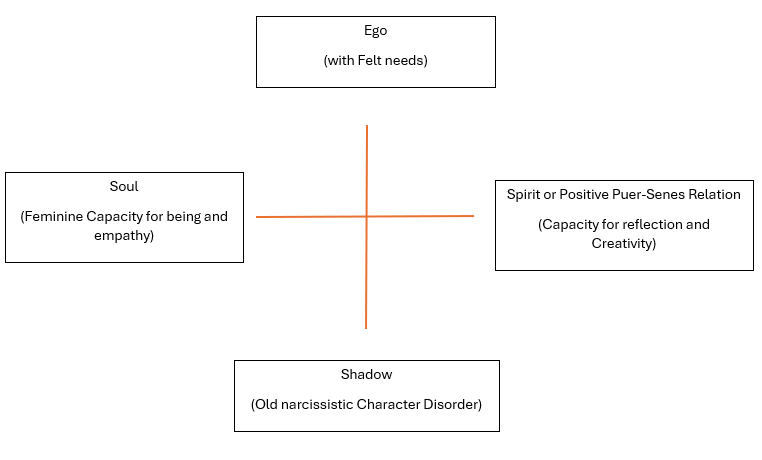
- The Black Magician gives way to a positive spirit; the self is felt as the content of the ego; the positive puer-senex (son, father) constellation emerges as an embodied awareness and compulsive doing becomes reflection.
- The False Bride gives way to the true soul, and the positive value of suffering emerges: the capacity to be appeara and relatedness, as opposed to being right, become primary values. Caring for one’s soul becomes meaningful, and empathy develops.
- The ego disengages from the persona and becomes the carrier of one’s personal identity; the capacity to feel and express another person’s needs emerges. The capacity to express anger in a related manner develops, and recognition ot the pettiness and rigidity of the ego is acknowledged.
- The shadow becomes the old narc structure, patterns and beliefs.
Transformation of the Masculine
The monstrous nature of the hermaphrodite is the premature forced union of opposites, in the realm of Narcissus. Previous attempts to separate are not yet differentiated into opposites, where archaic forms, such as projective and introjective, dominate. The world of the mother is neither all-encompassing nor yet releasing, and the elements of masculine existence are bound with the maternal, as a patriarchal uroborous. The negative hermaphrodite is a fusion of male and female elements where the ego merges and gender confusion develops, without a conscious eros union with others. The narc is in the realm of stuckness, the realm of nymphs, the domain of objects and mirrors or idealised transferences. The unconscious narc power leaves the object of desire feeling controlled, forced to fight for their sheer existence. narc represents psychic life in transit from the archetypal core, the dangerous risk of experiencing the self, the risks of inflation and loss of soul. Outer object relations alone never resolve the narc condition; without ever experiencing the inner object, the self, there is no transformation. The self-image has a largely feminine character, which represents the aspect of the self that was split off in the narcissistic personality. The shallow quality of the feminine resists change, which limits positive masculine functioning, moving from a spirit involved in power and overriding ambition to a connection with the demands of the self and its unfolding value. The process of integration and redemption of the emerging, split-off feminine soul requires a kind of masculine penetrating consciousness. The previous fear of object loss becomes a fear of truly opening up to ideas and uncertainty. The gain in self-esteem derived from others’ approval and acceptance, which was previously seductively satisfying, is now called into question. The loss of one’s independence and self-agency is challenged as no longer acceptable self-sacrifice. A new dialogue develops between the ego and the unconscious, each affecting the other.
Feminine Power
In passing into stage two of transformation, we go into the depths of ecstasy, which the narc fears, lest his fragile identity be devoured. During the passage of the depressive position, one suffers some loss to the soul, but retains a secret energised core of existence and psychic reality. When soul loss is extreme, there exists a schizoid state where the true self is split off and easily depleted of energy. In a normal schizoid state (regressed ego ), the split self is passive, withdrawn into a deathlike sleep, wholly without heart. There is an ego structure that is intensely alive and excludes a sense of power, which remains connected to a greater archetypal dimension. The split-off self reaches out to split off ebegries of joy, infused with joy and then expects a massive attack. A primary experience that attends narc dissolution is a growing awareness of not penetrating a person, not feeling into them. The ability to relate to the self in the here and now becomes of primary importance. The client can begin to trust their own imaginal sight. The analyst begins to relate as a nurturing parent, offering support, empathy, and a connection to the masochistic child. compliant, withdraw, and in control of their own territory, stubborn and hard to reach. An important development occurs when the client can feel their anger about being abandoned, and be concerned about the anger, rather than withdrawing into depression or seeking recovery of narc equilibrium. The client is fearful of these energies, of acting out, and of being reckless, uncontrolled, seduced, and intoxicated by their irresistibility. There should be enough analytical vessels and a strong enough structure to stop acting out and serve as a natural inhibiting factor.

