
The glass prison and narcissism intersect around visibility, validation, and self-surveillance. Both feed on this environment, self-worth, narcissistic integrity, via approval and assurance by significant others, which amplifies or collapses their grandiosity.
In a glass prison, people internalise constant visibility and begin to monitor themselves, self-censoring and conforming to perceived norms to secure social acceptance. In narcissism, the self is organised around being seen, admired, and affirmed by an audience, making external visibility a primary psychological currency.
The glass prison makes everyone watchable and watching; social media turns that into a stage for curated self-display. Surveillance architectures (feeds, profiles, metrics) encourage people to present idealised versions of themselves and to measure worth via likes, comments, and follower counts. Research shows that narcissistic traits are associated with more self-oriented, status-signalling activity on platforms, using them as a “two-way mirror” to both look and compare oneself to others and to confirm one’s own specialness.

Self-surveillance works when people internalise the gaze, tone, and behaviour of others and become their own guards; they adjust their behaviour because they might be perceived as imperfect and not good enough. Narcissism intensifies this: the self is constantly imagined from the outside, as if seen through an internal camera that judges appearance, status, and performance in comparison with an internal ego ideal. This creates compulsive self-monitoring and comparison in digital spaces, social events and workplaces, where the question is always, “How will this look? What will this do to my image? What will people think of me?”
In a glass prison, there is no single guard; power is distributed across a network of peers who observe, compare, and judge one another. Narcissistic dynamics slot neatly into this: people compete for attention, status, and moral superiority, using shaming, cancel culture, or conspicuous virtue as means to elevate the self and downgrade others. Studies on “narcissism economy” and social media show that status-seeking and rivalry drive conspicuous consumption and performative behaviour, reinforced by visible metrics and constant comparison.
The glass prison produces anxiety, stress, and a loss of spontaneity because life feels permanently on display, where the true self is inhibited and trapped, under constant internal scrutiny and judgment. Vulnerable narcissism—marked by oversensitivity to evaluation and rejection—is especially reactive to this climate, using social media for reassurance yet suffering when feedback is critical, absent, or exclusionary. The result is a population that is both self-absorbed and deeply insecure: endlessly curating the self for the network while feeling trapped within imaginary walls by the same visibility that promises validation.
The glass prison, narcissistic projection and the internalised inner critic all work through a “gaze” that shapes behaviour and identity, even when no one is visibly present.
- In the glass prison, the individual internalises the other’s gaze and begins to monitor and discipline themselves, becoming “the principle of their own subjection.”
- In narcissistic projection, the narcissist cannot tolerate their own flaws, so the mind creates an internal “judge” that insists “I must stay perfect,” then pushes any unacceptable traits outward onto others.
- In an inner critic, early external critics (parents, teachers, peers) are absorbed and replayed as an internal voice that constantly evaluates, shames, and corrects the self, like a privatised, ever-present overseer.
All three use fear or shame (of punishment, exposure, or worthlessness) to regulate behaviour: the collective gaze threatens alienation and loss of significance, projection threatens ego-collapse, and the inner critic threatens self-annihilating shame.
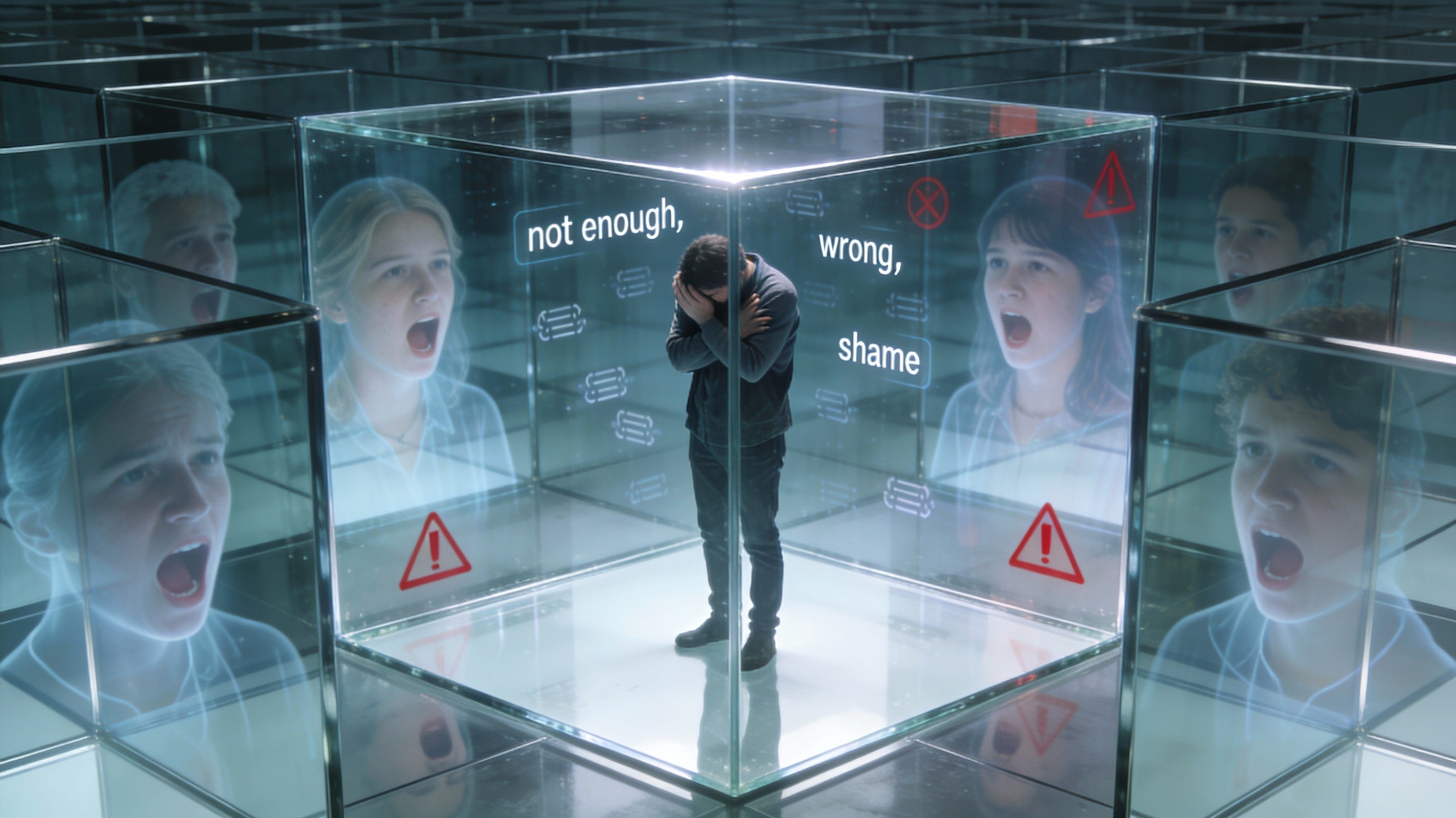
Over time, this monitoring becomes automatic, ingrained, and habitual, so the system no longer requires overt external enforcement; the person polices themselves from within. Narcissistic projection and the inner critic begin as internal conflicts, but their power and libido are distributed across relationships and self-talk. The greater the need for approval and validation, the greater the preoccupation and seeking of an idealised object. The individual’s self-esteem is based on an external locus of control, which determines their mood, state of mind, and behaviour.
They are more prone to passive, emotion-focused coping (avoidance, denial, blaming circumstances) rather than active problem-solving, which can keep them stuck. These people feel outcomes are primarily due to luck, fate, or powerful others, and tend to experience more depression and anxiety due to perceived helplessness and hopelessness. Self-agency is ceded to approval and conformity, as individual effort feels pointless and unrewarding, and is not immediately gratified or acknowledged, leading them to rejoin the collective in a mask of belonging and happiness; however, in a deeply diminished, emotion-derived state, where their ego remains weak, fragile, and incapable of self-assertion and agency.

